Friday, 17 May 2013
Contamination in cell culture
Nice contamination in the HL-60 cells today!! Bacilli and maybe fungus..........
And a close-up just for the guilty party!!

Saturday, 9 March 2013
Moths
Got the trap out last night, trying to take advantage of a bit of warmth before the predicted snow! Worthwhile as well with 5 species:

Common Quaker

Satellite (new for me)
March Moth
Hebrew Character
Dotted Border
 This flightless female Dotted Border appeared on the wall this week as well.

Common Quaker

Satellite (new for me)
March Moth
Hebrew Character
Dotted Border

Saturday, 2 March 2013
Species numer 900
Polytrichum commune (Common Haircap Moss) from Ayelsbeare on Monday when I was visiting a student on placement. 900 isn't much to shout about but they do say that it is not the size that matters but if it gives you pleasure anyway.......
 |
| Damp woodland at Ayelsbeare that provided 3 moss ticks! |
 |
| Polytrichum commune |
Sunday, 17 February 2013
I'm not dead
....at least I don't think so. Winter is always a bit of a quiet time but being busy and taking part in the 1000for1ksq challenge have been taking up a bit too much time.
Anyway, I stuck the moth trap on last night in hope and had the first moth of the year in the trap!
I have also started trying to identify some micros - below is the 6th micro species I have seen - apparently Acleris umbrana which is meant to be a pretty good record! Beginners luck.....

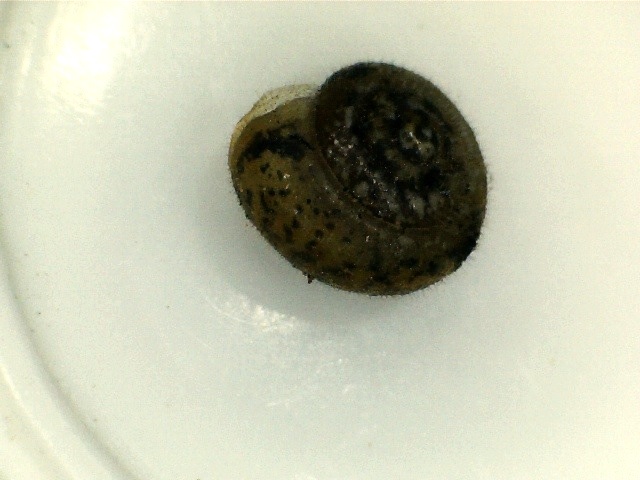
The 100for1ksq challenge has been forcing me to look at stuff I would previously have ignored. Below is (probably) Ashfordia granulata which if you look very closely has a hairy shell.... Who knew!

Anyway, I stuck the moth trap on last night in hope and had the first moth of the year in the trap!
 |
| Hebrew Character |

 |
| Agonopterix heracliana |
Wednesday, 30 January 2013
Pan Species List Update
I haven't forgotten about PSL and have been adding quietly. Update as of end of Jan 2013. Biggest increases in moths and plants and a few groups now with a nice 1 instead of a 0! Getting involved in the 1000 for 1kSq challenge has made me have a look at some new groups and buy some nice shiny new books......
| Moths | 143 | Macros 138, Micros 5 (+36) | |
| Birds | 303 | (+1) | |
| Vascular Plants | 178 | (+24) | |
| Beetles | 23 | (+2) | |
| Craneflies, True Flies, Hoverflies | 3 | (+1) | |
| Butterflies | 27 | ||
| Bees, Wasps, Ants, Sawflies | 11 | ||
| Bugs, Hoppers & Aphids | 0 | ||
| Fungi & Slime Moulds | 35 | (+1) | |
| Terrestrial Mammals | 32 | ||
| Terrestrial & Freshwater Molluscs | 12 | (+7) | |
| Dragonflies & Damselflies | 30 | ||
| Spiders & Harvestmen | 1 | (+1) | |
| Lichens | 1 | (+1) | |
| Crickets & Grasshoppers | 5 | ||
| Amphibians & Reptiles | 8 | ||
| Marine Molluscs, Crustaceans etc | 14 | (+2) | |
| Centipedes & Millipedes | 2 | ||
| Woodlice & Freshwater Crustaceans | 13 | (+1) | |
| Mosses & Liverworts | 1 | (+1) | |
| Lacewings & Scorpionflies | 0 | ||
| Caddisflies | 0 | ||
| Worms & Leeches | 0 | ||
| Silverfish, Springtails & Bristletails | 1 | ||
| Freshwater Fish | 22 | ||
| Mites & Ticks | 2 | (+1) | |
| Seaweed | 4 | ||
| Cockroaches | 0 | ||
| Earwigs | 1 | ||
| Fleas | 0 | ||
| Lice | 0 | ||
| Stick Insects | 0 | ||
| Marine Fish | 9 | (+1) | |
| Mayflies | 0 | ||
| Stoneflies | 0 | ||
| Total | 881 | ||
Tuesday, 8 January 2013
Geeky post alert
I'm allowed to be geeky every now and again.
Yesterday evening I found Garlic Snail finally (Oxychilus alliarius)

One of the ID features of this species is that it exudes a strong Garlic smell upon handling (or fingering as quoted in many places). Once Dr Boden had stopped sniggering, he found the compound responsible: n-propanethiol (below). Nothing like the compound allicin that gives garlic its smell (also below).
n-propanethiol is very volatile (it boils at about 60 degrees) so evaporates very quickly thus why the smell from the snail disappears quickly unlike garlic. Interestingly, allicin is not found in garlic as such. When you crush or cut garlic, allicin is formed enzymatically from alliin.
n-propanethiol is very similar in structure to n-butanethiol (just an extra CH2 in the chain) and n-butanethiol is one of the compounds that give Skunks their smell. Rearrange the chain of n-butanethiol slightly and you get the compound below - tertbutylthiol. This is the compound that is added to domestic gas supplies so you can smell the gas (methane is odourless).
For anyone who has had the pleasure of eating white truffles (or even truffle oil), you will know that they also smell a bit like domestic gas but this is due to another (mixture) of compounds, one of the principle compounds being 2,4-dithiapentane (below). All of these compounds are very volatile and contain sulfur (they are known as VOSCs - volatile organic sulfur compounds) and the slight differences in their structures give them different odours. In this family is also DMS, dimethylsulfide, the attractant they mix with chum to attract seabirds.
For a really good example of how little changes in chemical structure can give completely different smells, look at the two compounds below:
The top compound is eugenol, the volatile oil characteristic of cloves while the other is vanillin, the odor of vanilla. These two are very similar chemically (mix eugenol with wood pulp waste from paper making and it becomes vanillin) but have a completely different odor.
Enough geekiness - I'll try and stick to organisms for a bit.
Yesterday evening I found Garlic Snail finally (Oxychilus alliarius)

One of the ID features of this species is that it exudes a strong Garlic smell upon handling (or fingering as quoted in many places). Once Dr Boden had stopped sniggering, he found the compound responsible: n-propanethiol (below). Nothing like the compound allicin that gives garlic its smell (also below).
 | ||||||
| n-propanethiol |
 |
| Allicin |
n-propanethiol is very similar in structure to n-butanethiol (just an extra CH2 in the chain) and n-butanethiol is one of the compounds that give Skunks their smell. Rearrange the chain of n-butanethiol slightly and you get the compound below - tertbutylthiol. This is the compound that is added to domestic gas supplies so you can smell the gas (methane is odourless).
 |
| tert-butylthiol |
For anyone who has had the pleasure of eating white truffles (or even truffle oil), you will know that they also smell a bit like domestic gas but this is due to another (mixture) of compounds, one of the principle compounds being 2,4-dithiapentane (below). All of these compounds are very volatile and contain sulfur (they are known as VOSCs - volatile organic sulfur compounds) and the slight differences in their structures give them different odours. In this family is also DMS, dimethylsulfide, the attractant they mix with chum to attract seabirds.
 |
| 2,4-dithiapentane |
For a really good example of how little changes in chemical structure can give completely different smells, look at the two compounds below:
 |
| Eugenol |
 |
| Vanillin |
Enough geekiness - I'll try and stick to organisms for a bit.
Saturday, 5 January 2013
Challenges
Most people set out their resolutions for the new year at about this time - I can't be bothered with resolutions as I know that they will never last beyond the first weekend of the year. Instead, I have been looking for challenges for the year. I have picked two this year, made all the easier by other people having organised them and telling me exactly what I need to do! The first is a simple birding challenge, the Patchwork Challenge. All you need to do is choose an area of less than three square km and record as many species as you can in the calendar year. I kind of do this anyway with our (non)-competitive Wembury year list but I have bent the rules for the Patchwork Challenge, stretching the patch to include the garden to nick a few extra species. Seeing as I don't get too much time to get out on the patch, the garden is one of my prime sources of birds.
The second is all together more involved. It is the 1000for1ksq challenge. This involves trying to see 1000 species of anything within a 1 km square. I have chosen my home square SX5249.

I am never going to get even close to 1000 species but it is worth a try. I have seen 6 new species today all within 1 km of my house so it can't be too bad! It also forces me to look at groups I might otherwise shy away from!
 |
| Patchwork area (2.663 km squared) |
I am never going to get even close to 1000 species but it is worth a try. I have seen 6 new species today all within 1 km of my house so it can't be too bad! It also forces me to look at groups I might otherwise shy away from!
Subscribe to:
Posts (Atom)